


When designing a perimeter system for a commercial, municipal, or industrial site, choosing the right type of fencing is a critical decision. Not all fencing systems are built to the same standard, and understanding the difference between basic perimeter barriers and high-security fencing can significantly impact safety, compliance, and long-term performance.
Understanding Standard Fencing Systems
Standard fencing typically includes:
- Light- to mid-gauge steel or aluminum construction
- Wider spacing between pickets or mesh openings
- Simpler post and panel connections
- Conventional gate systems without reinforced hardware
These systems are often prefabricated and selected for ease of installation and cost efficiency. While they provide a visible barrier, they are not engineered to resist cutting, climbing, or forced entry over extended periods.
These types of fencing can be useful in the right places, but they won’t provide the highest standards of security. Typically, they are used for appropriate needs, such as parks, retail centers, multi-use properties, public spaces, or low-risk facilities.
In these environments, fencing serves more as a deterrent and organizational feature than a true security system.
What Defines High-Security Fencing?
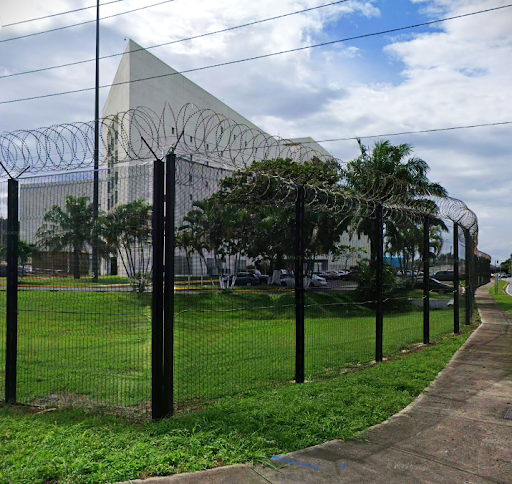
High-security fencing is fundamentally different in both design intent and execution. Rather than simply marking a boundary, it is engineered to withstand, delay, and discourage intrusion attempts.
At its core, high-security fencing is not just another fencing product. It is often a custom fabricated system, one that is custom-built to meet the specific requirements of the site.
High-security systems typically incorporate features such as:
- Heavy-gauge steel construction for increased strength and impact resistance
- Tight spacing or anti-climb configurations to eliminate footholds
- Fully welded or reinforced panel assemblies to prevent tampering
- Extended heights and security toppings such as anti-climb extensions
- Custom-fabricated gates with reinforced frames and secure locking mechanisms
At MFR Corp, these systems are often developed through custom metal fabrication, allowing for tailored solutions that integrate seamlessly with the surrounding architecture and operational needs.
Material and Fabrication Differences
One of the most important distinctions between standard and high-security fencing lies in material selection and fabrication methods.
Standard Systems
- Often use lighter materials to reduce cost
- May rely on modular or bolted components
- Limited customization options
High-Security Systems
- Utilize structural-grade steel or aluminum, depending on the application
- Feature precision welding and fabrication for enhanced durability
- Include protective finishes such as coatings designed to withstand corrosion and environmental exposure
Because MFR Corp specializes in architectural and industrial metalwork, their fencing systems are built with the same attention to detail as other structural and design elements. This ensures both performance and longevity.
Structural Integrity and Performance
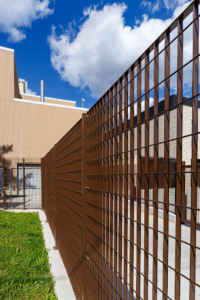
Standard fencing provides a basic level of resistance, but it is not designed to endure sustained force or targeted intrusion. High-security fencing, by contrast, is engineered with performance under stress in mind.
When it comes to performance, details like these make a difference:
- Cut resistance: Thicker materials and welded joints make cutting more difficult
- Climb resistance: Tight spacing and smooth surfaces reduce grip points
- Impact resistance: Reinforced posts and panels withstand forceful attempts to breach the system
- System rigidity: Fabricated panels maintain structural integrity under pressure
This level of performance is especially critical in environments where security breaches could result in operational downtime, safety risks, or regulatory violations.
Integration with Access Control and Perimeter Systems
Another major distinction is how the fencing system interacts with the broader site infrastructure.
Here, you will find that most standard fencing tends to stand alone. It doesn’t have many add-ons or extras because that simply isn’t the purpose. There is minimal integration with security systems as well.
However, high-security fences are typically part of a more comprehensive perimeter strategy. They integrate and work in correlation with access-controlled gates, surveillance systems, vehicle barriers, and entry management systems.
Custom fabrication plays a key role here, as components such as gates, frames, and mounting systems must align precisely with both security equipment and site layout.
Applications and Industry Use
The choice between standard and high-security fencing often comes down to application and risk level.
Standard Fencing Applications
- General commercial properties
- Public-access facilities
- Low-risk storage areas
High-Security Fencing Applications
- Industrial manufacturing facilities
- Utilities and energy infrastructure
- Data centers and telecommunications sites
- Transportation hubs and logistics centers
- Government and municipal facilities
These are just some broad examples. They are not all-inclusive or absolute. Ultimately, the question is whether said fencing is a critical layer of protection and what is required to support that need as well as operational continuity and regulatory compliance.
Cost Considerations and Long-Term Value
It’s true that high-security fencing often requires a higher upfront investment, but focusing only on initial installation cost can overlook the bigger financial picture. Standard fencing may seem more budget-friendly at first, yet it is generally more vulnerable to damage, intrusion, and wear over time. This can lead to more frequent repairs, replacements, and potential security risks that carry their own costs.
In contrast, high-security fencing is designed with durability and performance in mind. Using stronger materials and custom fabrication methods, these systems tend to last longer and require less ongoing maintenance. They also provide a higher level of protection, reducing the likelihood of breaches that could disrupt operations or result in costly losses.
Planning Considerations for Perimeter Projects
When selecting a fencing system, several technical and strategic factors should guide the decision. Let’s look at three primary parts of making the decision and what details to consider in each one.
Risk Assessment
- What assets need protection?
- What level of threat is present?
- Are there compliance or regulatory requirements?
Site Conditions
- Terrain and layout
- Environmental exposure (corrosion, weather, etc.)
- Access points and traffic flow
Customization Needs
- Integration with architectural elements
- Specialized gate systems
- Unique dimensional or structural requirements
Working with a fabrication-focused partner like MFR Manufacturing allows a fully customized approach. This leads to ensuring that every component, from panels to gates, is designed to meet the specific demands of the project.
Count on High-Security Fencing with MFR Corp
Choosing between standard fencing and high-security fencing is ultimately a decision about risk, performance, and long-term reliability. While standard systems may be suitable for low-risk environments, high-security solutions provide the strength, durability, and engineered design needed to protect critical infrastructure and commercial operations.
At MFR Corp, we design and fabricate custom metal fencing, gates, and architectural systems built for demanding environments. If you’re planning a perimeter project, our team can help you develop a solution. Contact us today to get started.