


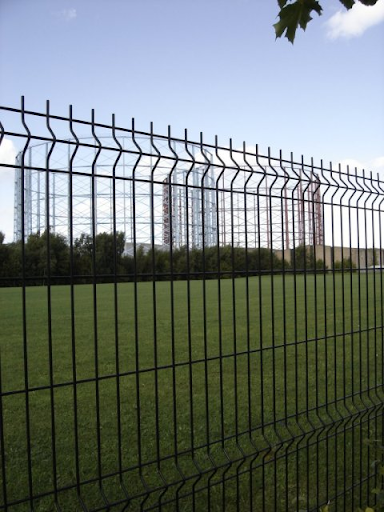
Industrial perimeter design must address more than property boundaries. The fence may protect employees, production areas, utilities, hazardous materials, equipment, and other critical assets from unauthorized access. Effective secure perimeter fencing begins with a clear threat assessment and continues through panel selection, post and foundation design, gate coordination, finish requirements, and complete construction documentation. Specifiers must connect each component to the site’s actual security and operating needs.
Begin with the Site’s Security Requirements
A successful specification starts with a clear understanding of what the perimeter must protect. Manufacturing plants, utility facilities, chemical processing sites, equipment yards, warehouses, and distribution centers do not necessarily face the same risks.
Before selecting a system, identify:
- Assets and restricted areas requiring protection
- Likely trespassing, vandalism, or intrusion risks
- Required resistance to climbing, cutting, and tampering
- Vehicle and pedestrian access points
- Surveillance and visibility requirements
- Applicable owner, agency, or regulatory standards
- Environmental and site conditions
- Desired service life and maintenance expectations
Not every property line requires the highest level of protection. An exterior boundary near a public area may have different requirements from an enclosure surrounding hazardous materials or critical utility equipment. Separating the site into security zones can help specifiers apply stronger measures where they are justified without adding unnecessary cost everywhere else.
Match the Fence Design to the Threat Level
Mesh dimensions, wire configuration, height, rigidity, and attachment methods all affect security performance. The phrase “high-security fence” is not specific enough for a construction document. Drawings and specifications should identify measurable product requirements.
For higher-risk applications, our Metalco Securite system uses 1/2-inch by 3-inch welded wire mesh. Its narrow openings limit finger and toe holds, making the panel difficult to climb. The tight mesh also restricts the use of larger cutting tools. Securite is available in horizontal and vertical orientations, with flat and reinforced V-bend options available for different design needs.
For industrial boundaries that require a rigid welded wire panel with greater openness, Metalco Twinbar may be appropriate. Its double horizontal wire design creates a strong, stable panel while maintaining visibility through the perimeter. System selection should follow the threat assessment. Securite may be preferred around high-risk equipment, utilities, chemical operations, or restricted areas. Twinbar may fit broader industrial boundaries where durability, visibility, and controlled access are priorities without the need for tighter anti-climb mesh.
Consider Height Without Overlooking the Rest of the System
Fence height contributes to deterrence, but height alone does not determine effectiveness. Taller panels increase wind exposure and may require larger posts, deeper foundations, additional bracing, or stacked panel configurations.
Specifiers should evaluate height together with:
- Panel construction
- Post dimensions and spacing
- Foundation and anchorage design
- Ground clearance
- Top security features
- Adjacent structures or objects that could assist climbing
Equipment, trees, utility boxes, retaining walls, and parked vehicles near the fence may reduce its effective height. Maintaining an appropriate clear zone on both sides can improve visibility and remove opportunities to bypass the barrier.
Uneven terrain also deserves careful attention. A fence that follows a slope poorly may leave openings beneath the panels. Stepped layouts, grading adjustments, custom panels, or revised post spacing may be needed to maintain consistent protection.
Specify Posts, Foundations, and Connections
A fence panel cannot perform as intended if it is supported by undersized posts or inadequate foundations. Post size and embedment should account for overall height, panel type, wind loads, soil conditions, frost depth, terrain, and any added toppings or security devices.
Our Metalco systems use high-strength steel posts and coordinated attachment hardware. Tamper-resistant connections are available where additional protection is needed. Depending on the project, posts may be embedded in concrete or supplied with base plates for attachment to a suitable structure.
Drawings should clearly identify post spacing, anchorage, bracing, corners, terminal conditions, grade changes, and transitions. Generic details should not replace project-specific engineering when unusual soil, wind, structural, or security conditions are present.
Treat Gates as Part of the Security System
Gates are often the most frequently used components and potential weak points within an industrial perimeter. Their design should provide security consistent with the adjoining fence while supporting efficient movement.
MFR Corp offers swing, cantilever slide, V-track slide, telescoping, and specialty gate configurations. Selecting among them requires consideration of opening width, available swing or stacking space, grade, traffic volume, operating frequency, and weather conditions.
Gate specifications should address:
- Frame and infill construction
- Gate posts and foundations
- Hinges, rollers, tracks, and other hardware
- Locking and latching arrangements
- Clear opening and ground clearance
- Manual or automated operation
- Emergency access
- Access-control and safety equipment
Automated gates require early coordination with electrical service, operators, vehicle detection, safety devices, card readers, and other controls. Waiting until installation to resolve these details may result in clearance problems or incompatible components.
Provide Complete Construction Documents
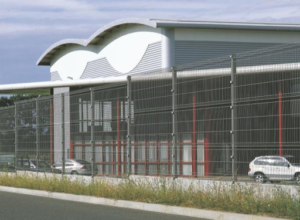
Clear drawings and specifications help prevent substitutions, installation conflicts, and gaps in security. We recommend defining the fence as a complete system rather than specifying panels while leaving posts, hardware, gates, and finishes open to interpretation.
Submittals should include product data, shop drawings, gate details, finish samples, installation instructions, and warranty information. Installation drawings should identify layouts, dimensions, post spacing, anchorage, bracing, gate movement, operational clearances, and access-control interfaces.
MFR Corp provides CAD drawings and downloadable specifications for our fencing and gate systems. Our engineers and architects can also assist with custom enclosures, unusual corners, grade changes, special gate conditions, and other project-specific requirements.
Coordinate Physical and Electronic Security
A fence functions best as part of a larger perimeter plan. Lighting, cameras, access controls, intrusion detection, and clear zones should be coordinated with its alignment and openings.
Welded wire panels provide visibility through the perimeter, allowing cameras and security personnel to monitor activity without the obstruction created by solid barriers. Camera placement should account for posts, gates, vegetation, lighting conditions, and potential blind spots.
Additional Metalco security options include vandal-resistant hardware, angled tops, barbed wire, razor wire, reinforcement, electrification provisions, and sensor wiring. These features should be used intentionally according to the threat level and project requirements. Public exposure, worker safety, maintenance access, and local restrictions must be considered before aggressive toppings or electrified components are specified.
Build a Coordinated Industrial Perimeter
Effective secure perimeter fencing results from coordinating security goals with panel selection, height, posts, foundations, gates, coatings, and monitoring systems. A well-written specification gives contractors measurable requirements while helping owners avoid both weak points and unnecessary features.
At MFR Corp, we design and manufacture American-made Metalco fencing and gate systems for industrial, utility, chemical, government, and other demanding environments. Whether your project calls for Securite, Twinbar, or a custom solution, our team can provide the technical guidance and design resources needed to move forward. Contact us to discuss your project and request a quote.