


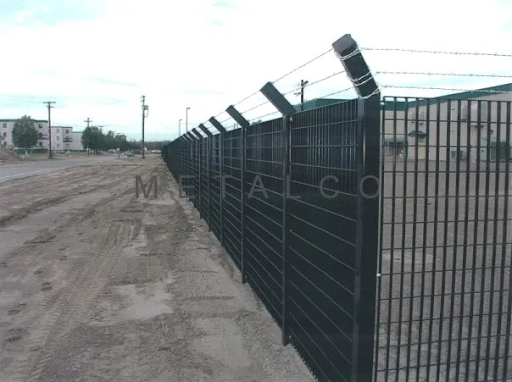
Substation fencing must support a utility’s physical security strategy while accommodating electrical safety, maintenance access, and site conditions. For engineers and project managers, the challenge is translating identified risks into specifications that contractors can build and owners can maintain.
At MFR Corp, we help project teams evaluate welded steel perimeter systems and their installation details. Understanding NERC CIP-014’s role is an important starting point: a fence contributes to the protection strategy, but purchasing a particular product does not establish compliance.
Understand the Standard Before Specifying Products
CIP-014 addresses certain transmission facilities and associated primary control centers whose loss could cause instability, uncontrolled separation, or cascading within an interconnection. It does not automatically apply to every distribution or transmission site.
Under CIP-014-3, the process includes:
- R1–R2: Transmission risk assessment and unaffiliated third-party verification
- R3: Notification of relevant transmission operators
- R4: Evaluation of physical threats and vulnerabilities
- R5: Development and implementation of documented physical security plans
- R6: Unaffiliated third-party review of the evaluation and plans
R5 calls for measures that collectively deter, detect, delay, assess, communicate, and respond. It also addresses law enforcement coordination, implementation timelines, and evolving threats. It does not prescribe one universal fence height, mesh opening, or product certification.
Confirm the applicable standard version and implementation obligations with the utility’s compliance team before finalizing procurement documents.
Translate Security Objectives into Measurable Requirements
We recommend establishing the barrier’s intended function before comparing panel options. Is the project addressing unauthorized pedestrian access, limiting climbing opportunities, supporting intrusion detection, or separating public areas from restricted equipment?
Those objectives require different evidence. An anti-climb configuration does not establish ballistic resistance. A rigid steel panel does not establish a vehicle-impact rating. Where the assessment requires those protections, request relevant testing for the proposed assembly and coordinate separate protective measures as necessary.
For substation fencing, specifications should identify the complete assembly: infill, posts, connections, foundations, gates, and transitions. Security claims should describe the tested configuration and performance criteria rather than rely on terms such as “heavy duty.”
Evaluate Mesh Geometry and Structural Continuity
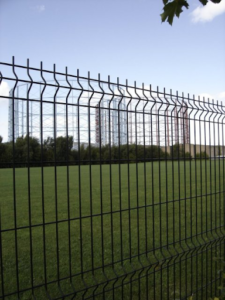
Our METALCO SECURITE system uses welded steel mesh with nominal 1/2-inch by 3-inch openings and 8-gauge wires. We offer horizontal SECURITE D and vertical SECURITE M configurations. SECURITE D is available with V-bend reinforcement; additional horizontal bracing is another option for applicable configurations.
Small mesh openings restrict footholds and access for larger cutting tools. However, the installed barrier’s performance also depends on how forces travel through connections into posts and foundations.
During design review, evaluate:
- Panel orientation and reinforcement requirements
- Post spacing, section properties, and supported height
- Fastener accessibility and tamper-resistant hardware
- Panel joints, corners, and connections to structures
- Bottom clearances across changing grades
Our SECURITE system includes panels, posts, attachment hardware, and compatible gates. Its modular format helps teams coordinate these components, but project-specific engineering remains necessary.
Coordinate Foundations, Grading, and Electrical Safety
Foundation design should reflect geotechnical conditions, frost exposure where applicable, fence height, and governing structural loads. Added screening changes wind exposure; foundations designed for open mesh should not be assumed adequate after privacy materials are attached.
Grading deserves equal attention. Stepped panels, drainage channels, and uneven ground can create unintended openings. Show allowable clearances and transition details on drawings so field crews have a defined installation standard.
Coordinate conductive steel components with the utility’s grounding engineer. Fence location, bonding, gate continuity, and proximity to the ground grid require review for touch and step potential. Gate movement and removable sections also need appropriate electrical details.
We recommend resolving these interfaces before fabrication. Structural shop drawings alone do not demonstrate that the installed perimeter meets the site’s electrical safety requirements.
Treat Gates as Engineered Assemblies
A strong perimeter still depends on reliable access points. Our gate offerings include swing, cantilever sliding, and V-track configurations, allowing teams to evaluate options against available space and operating needs.
Specify clear opening dimensions around actual maintenance activities, including equipment replacement and delivery access. Review gate travel, drainage, foundations, operator placement, and interference with surrounding equipment.
The hardware package should address locking, hinges or rollers, position monitoring, and authorized emergency access. For powered gates, coordinate entrapment protection and operating controls with the qualified gate-system designer.
Avoid leaving gate interfaces to separate trades without an assigned coordinator. Fence fabricators, civil contractors, electricians, and security integrators need consistent drawings and responsibilities.
Integrate Detection and Maintainability
A barrier delays access; detection and response arrangements determine how that delay supports the broader security plan. Review camera sightlines, lighting, sensor attachments, and vegetation management together.
Dense mesh, reinforcement, and equipment placement can affect visibility. Sensors also require compatible mounting details and commissioning so normal environmental movement does not undermine reliable operation.
For property managers, access to replacement components matters. Identify panel types, coating specifications, hardware, and gate parts in turnover documents. Record inspection criteria for loose connections, settlement, corrosion, damaged mesh, and gate alignment.
Galvanizing and polyester powder coating are available within our product range. Select the finish for the exposure and specify procedures for handling damage, field modifications, and repairs.
Build a Reviewable Submittal Package
We encourage teams to establish acceptance requirements before bidding. Request coordinated layout drawings, product data, structural calculations where required, foundation details, finish information, and gate schedules.
Include a responsibility matrix covering grounding, access controls, detection devices, testing, and final inspections. Document substitutions against the original performance requirements rather than accepting visual similarity.
Construction sequencing also needs attention at operating facilities. Define temporary protection, authorized work areas, and the conditions for removing existing barriers so perimeter upgrades do not create unmanaged gaps during installation or equipment deliveries.
Before turnover, reconcile field changes with approved drawings and provide inspection records, operating instructions, and maintenance information to the owner.
Specify a Perimeter That Supports the Plan
Effective substation fencing begins with the utility’s assessment and continues through coordinated engineering, installation, and verification. At MFR Corp, we help teams develop METALCO fence and gate solutions around defined project requirements. Contact us to discuss configurations, technical documentation, and perimeter details for your next utility project.