


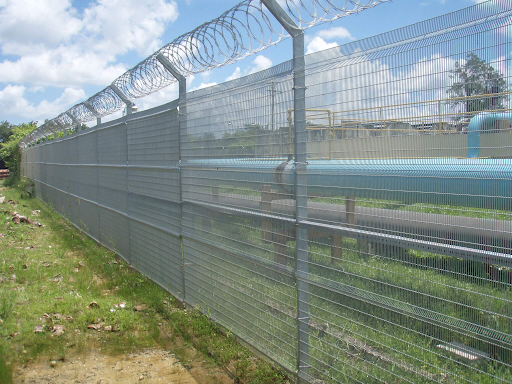
A data center perimeter has to support everyday operations while controlling who enters the property. Employees, service contractors, delivery drivers, and emergency responders may all need different routes or permissions. Effective data center perimeter security accounts for those movements when the civil layout, fence alignment, gate schedule, and access controls are still being developed. At MFR Corp, we help project teams select steel fencing and gates that fit the site layout, operating requirements, and maintenance plan.
Planning Data Center Perimeter Security Around Site Operations
Map the normal traffic pattern before assigning gates. The employee entrance may see short peaks during shift changes, while equipment deliveries may need wider openings and more room to queue. During an expansion, construction traffic may need its own controlled route so work can proceed while the occupied facility maintains its normal access procedures.
Give the civil, security, and operations teams a common plan to review. Resolve these items before ordering equipment.
- Vehicle circulation: Use the design vehicle’s turning path to confirm clear opening widths, approach geometry, and space for vehicles waiting for clearance.
- Pedestrian access: Coordinate dedicated pedestrian gates with accessible routes, credential readers, and applicable egress requirements.
- Emergency response: Confirm responder access and gate behavior during a power loss with the facility team and authority having jurisdiction.
- Future phases: Show where the permanent perimeter will terminate or extend, and assign responsibility for maintaining controlled access during construction.
Specify the Fence as a Complete System
The fence schedule should describe panels, posts, connections, anchorage, and finish together. Our METALCO SECURITE fence system uses tight welded steel mesh to limit handholds while preserving visibility through the fence. We offer horizontal and vertical mesh orientations and galvanized or galvanized and polyester powder-coated finishes. Review the finish against the expected exposure, including deicing salts near drives and persistent moisture near landscaped areas.
Coordinate fence elevations with the grading plan. On sloped runs, show how the panels follow the grade and establish the acceptable clearance beneath them. Include transitions at retaining walls and drainage features in the drawings. Ask the structural team to verify post spacing, foundations, and anchorage for site conditions. Where screening is proposed for privacy, account for the additional wind load and check camera sightlines before specifying the infill.
Require shop drawings that show how the fence connects to the gates and adjacent construction. Identify any field cuts or repairs that need an approved finish treatment. That detail helps preserve corrosion protection where installation work exposes the underlying steel.
Match Gate Type to the Opening
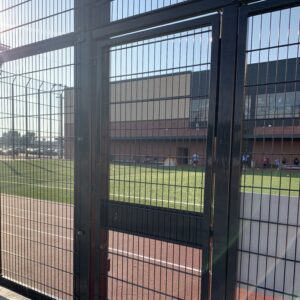
We offer METALCO swing gates and METALCO slide gates. Gate selection depends on the space available for movement, the grade at the opening, and the number of cycles the entrance is expected to handle. Use the schedule to record the clear opening, gate travel, operating method, and hardware at each location.
| Gate configuration | Where it may fit | What to verify |
| Swing gate | Service entrances with room for leaf movement | Swing envelope, grades, and clearance from vehicles and pedestrians |
| Cantilever slide gate | Driveways where a track across the opening would complicate operations | Side clearance, support foundations, and space for the counterbalance |
| Tracked slide gate | Openings with suitable pavement and room for lateral travel | Track alignment, drainage, and access for debris removal |
| Dedicated pedestrian gate | Staff and visitor routes separate from vehicle lanes | Latch and reader coordination, accessibility, and required egress |
Record gate usage assumptions in the equipment schedule, including peak traffic, expected cycles, and any periods when an entrance must remain open under supervision. Those assumptions help the supplier and controls contractor select compatible hardware and plan preventive service without relying on a generic duty cycle.
For automated gates, define who supplies and integrates the operator, safety devices, credential reader, and gate position monitoring. Coordinate these components before the electrical and concrete work begins. If the owner specifies a vehicle impact rating, identify a tested barrier assembly and coordinate the installation with its rated configuration.
During early design review, assign ownership of the interfaces between trades. The gate supplier may provide mounting details, while the civil and electrical teams coordinate foundations and conduit. Naming the party responsible for each connection gives the installer a clear point of contact when field conditions differ from the drawings.
Coordinate Detection, Access Control, and Response
A perimeter fence defines the boundary. Controlled entrances regulate passage, while cameras, lighting, and alarms help staff assess events and decide how to respond. Review those functions together. For example, the security team should confirm that lighting supports camera coverage at staffed and unstaffed entrances and that gate status appears where staff can act on it.
Restricted exterior areas may warrant their own controlled boundaries. Where the owner’s risk assessment calls for separate control around electrical or mechanical equipment, coordinate fencing and gates with utility access, equipment removal routes, and required working space. Review those clearances with the responsible party before fixing the fence alignment.
Give commissioning staff a written sequence for routine access, emergency access, and restoration after a power interruption. Include the personnel responsible for each action and the expected indication at the monitoring station. This lets the team verify that the physical equipment and controls respond together.
Plan for Acceptance and Ongoing Maintenance
Walk the completed perimeter with the owner before turnover. Document the installed condition and check the fence, gate hardware, and controls against the approved drawings and operating sequence.
- Fence inspection: Review alignment, clearance beneath panels, attachment hardware, and finish condition.
- Gate testing: Verify travel, position reporting, safety device operation, and the specified response to loss and restoration of power.
- Maintenance access: Confirm the facilities team can reach operators, hinges, rollers, and other service points, and record replacement part information.
Include the approved drawings and maintenance instructions in turnover documents. For phased campuses, update the site plan as each phase opens so operations staff know which entrances are active and which routes are reserved for construction.
Coordinate the Perimeter Before Procurement
Data center perimeter security works best when the fence, gates, and controls are specified around the same operating plan. Share your site plan, gate schedule, and finish requirements with our team at MFR Corp. We can review METALCO fencing and gate configurations and help identify fabrication details that need coordination before procurement.